Tired After Work? How to Preserve More Energy for Your Evening
When the workday is over, but the fatigue isn’t
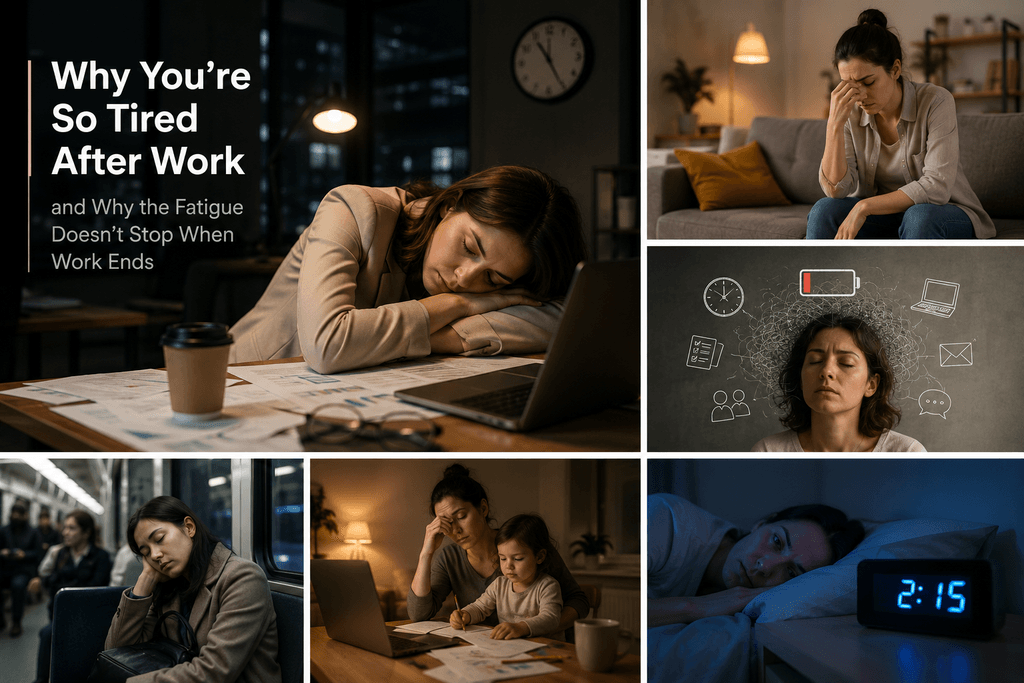
The laptop is closed. The messages have stopped. The workday is officially over. In theory, this is when you should have time for yourself, your family, your friends, or simply to relax.
But instead, all you want to do is lie down and do nothing. Conversations feel irritating. You have no energy for exercise. You don’t feel like seeing anyone. Even choosing a movie feels like one more decision you have to make.
Sometimes, feeling tired after work is simply the result of a demanding day. But when that exhaustion becomes a regular part of your evenings, the problem may not be how much free time you have. It may be the state you’re in when you finish work.
Persistent work fatigue can gradually take away not only your energy at work, but also the quality of your life after it.
Signs of work fatigue after a demanding day
The problem doesn’t always look like obvious exhaustion. It can show up in different ways:
you have almost no energy left for your personal life;
your mood gets worse;
you become more irritable;
you just want to be left alone;
interacting with people close to you feels harder;
you lose interest in exercise, hobbies, or other activities;
getting yourself to leave the house or meet friends feels difficult;
you gravitate toward the most passive forms of rest;
your thoughts keep returning to work;
mentally switching into rest mode is difficult;
you still feel tense in the evening;
it starts to feel as if life consists of working and then recovering from work.
You may still be perfectly capable of doing your job. The problem becomes most noticeable once the workday is over: you have enough resources for work, but not enough left for life.
Why fatigue doesn’t disappear when work ends
Mental workload doesn’t work like an on/off switch.
If you’ve spent the day maintaining concentration, processing large amounts of information, making decisions, and constantly switching between tasks, the accumulated fatigue doesn’t disappear the moment you close your laptop.
Research on recovery from work treats work and rest as parts of the same daily cycle. Throughout the workday, demands gradually consume available resources, while periods of rest allow those resources to recover. If the demands are consistently too high and there aren’t enough opportunities to recover during the day, you may reach the evening with a substantial need for recovery. As a result, part of your free time is spent not on your personal life, but on recovering from work.
In the scientific literature, this is often discussed through the concept of need for recovery. The greater the accumulated strain, the stronger the need to disengage from work demands and restore the resources you’ve used.
That’s why your brain naturally gravitates toward activities that require very little from you: lying on the couch, endlessly scrolling through your phone, or putting on a TV show.
It creates a paradox: you have free time, but no longer have enough energy to really use it.
Why work fatigue can make you more irritable
Fatigue can affect your emotional state as well.
After a demanding workday, you may have less patience for additional demands and distractions. Something you would barely notice in the morning can trigger a much stronger reaction in the evening.
A simple household request, a loud noise, having to go somewhere, or even an ordinary question can feel like one more demand placed on you.
This is where the effects of work fatigue can start spilling over into your relationships with other people.
In that case, the problem may not actually begin in the evening. You may already be arriving at that state during the workday.
It can be a sign that the balance between workload and recovery throughout the day is off.
Why it’s hard to mentally switch off after work
There’s another way work can spill into personal time: the computer is off, but work continues in your head.
You replay a conversation with a colleague, think about unfinished tasks, check messages, or mentally plan the next day.
Research on recovery highlights the importance of psychological detachment from work.
That doesn’t mean literally forgetting that your job exists. It means being able to temporarily step out of work mode.
When you’re highly fatigued, making that transition may require additional effort. If your available resources are already low, it may be easier to keep following the familiar mental track of work, replaying the same tasks and conversations, than to deliberately shift your attention to something else.
That creates another paradox: to fully begin recovering, you may first need enough resources to make the transition from work to rest.
How work fatigue can become a cycle
When work fatigue regularly carries over into the evening, a simple cycle can develop:
high workload during the day → severe fatigue in the evening → poorer recovery → starting the next workday with fewer available resources → fatigue building faster.
That’s why it matters to look not only at how productive a particular workday was, but also at the state you’re in when it ends and how ready you are to shift toward recovery and your personal life.
If consistently working at high intensity comes at the cost of losing your entire evening, that pattern is difficult to sustain.
Over the long term, chronic insufficient recovery is considered one of the factors associated with poorer well-being and an increased risk of occupational burnout.
How to have more energy after work
If you work for several hours with little or no recovery, one long break after the workday ends may not necessarily compensate for everything that has accumulated.
That’s why the solution doesn’t necessarily start in the evening. It makes sense to manage your workload and recovery before the workday is over.
Taking breaks at the right time, distributing tasks according to their difficulty, doing the most demanding work during periods of higher capacity, and shifting lighter tasks to periods of fatigue can help you use your available resources more effectively.
This isn’t only about maintaining performance at work. It can also help you preserve more energy for your evening and personal time, so you have enough resources not just to finish your work, but to have a life after it.
How Advancify helps you preserve energy after work
If you don’t want to end every workday completely drained, it’s important to understand not only how long you work, but also how your available resources change throughout the day.
Advancify helps you see these patterns.
The Mental Energy and Cognitive Reserve metrics are based on an analysis of your individual screen interaction patterns and signals that Advancify tracks through the camera and processes locally on your device. Its algorithms analyze how these patterns change over time and adapt to your individual baseline.
Based on these patterns, Mental Energy helps track changes in your readiness for sustained mental work, while Cognitive Reserve helps estimate how much capacity remains for demanding cognitive tasks at different points throughout the day.
Over time, this can help you better understand your own working rhythm: when demanding intellectual work tends to feel easier, which periods of work are followed by faster declines in your state, and when recovery helps preserve resources for the rest of the day.
With these patterns in mind, you can distribute cognitive demands more intentionally: do your most demanding tasks during more suitable periods, alternate between intensive and lighter work, and avoid postponing recovery until you’re completely depleted.
The goal isn’t to work less. It’s to manage your available resources more effectively throughout the day instead of using them all up long before work is over.
A productive workday shouldn’t cost you your entire evening
The number of tasks you complete isn’t the only measure of a good workday.
What you have left afterward matters too.
If you regularly finish work with no energy for family, friends, exercise, hobbies, or your own plans, the problem may begin much earlier, in how workload and recovery are distributed throughout the working day.
A well-managed workday isn’t just one in which you get a lot done. It’s one that still leaves you with enough energy for your own life afterward.
Sources
Sluiter J.K. et al. (2003). Need for recovery from work related fatigue and its role in the development and prediction of subjective health complaints. Occupational and Environmental Medicine.
Sonnentag S., Fritz C. (2015). Recovery from job stress: The stressor-detachment model as an integrative framework.Journal of Organizational Behavior.
Bennett A.A., Bakker A.B., Field J.G. (2018). Recovery from work-related effort: A meta-analysis. Journal of Organizational Behavior, 39, 262–275.